Meet the Panelists:

Jason Bazylak
Dean’s Advisor on Indigenous Initiative, and Professor, Teaching Stream
Faculty of Applied Science and Engineering (FASE)
Jason Bazylak is a Metis (Duck Lake) Professional Engineer, Faculty of Applied Science and Engineering (FASE) Dean’s Advisor on Indigenous Initiatives, and Professor Teaching Stream. He has taught engineering design for 20 years, researches the under-representation of women and Indigenous people in engineering, and is raising three “future engineers.” He was the co-chair of the Eagles’ Longhouse who jointly wrote, with Indigenous partners, the Blueprint for Action. A plan for the FASE to address the Calls to Action from the TRC. In the Metis tradition he bridges the cultures of the Education and Engineering for the betterment of his students.
Andrea Johns
Program Manager, Indigenous Initiatives
Jackman Faculty of Law
Andrea is a member of the Kanien’kehá:ka/Mohawk Nation from Six Nations of the Grand River and a proud graduate of the University of Toronto. She holds an Honours Bachelor of Arts with High Distinction, specializing in Indigenous Studies, with a double minor in Book and Media Studies and Creative Expression and Society.
Andrea brings a wealth of experience in Indigenous education, community engagement, and program coordination, with a strong commitment to Indigenous language revitalization and land-based learning. During her undergraduate studies, she founded the Indigenous Languages Club to create space for peer-based language learning and community connection. She also completed both Introductory and advanced Kanien’kéha courses through the Centre for Indigenous Studies and continues to support language revitalization initiatives in her professional and community work.
She is the Program Manager for the Indigenous Initiatives Office at the Jackman Faculty of Law. Most recently, she served as the Indigenous Training Coordinator with the Office of Indigenous Initiatives at the University of Toronto. Prior to that, she worked as an advisor at the Ontario Federation of Indigenous Friendship Centres, supporting areas such as communications, Indigenous employment and education, and the Indigenous Languages Revitalization Program.
In addition to her professional work, Andrea is also an accomplished beadworker and artist. Her creative work has been featured at the Indigenous Fashion Arts Festival, the Museum of London, and Aaniin Hello, and is available in the gift shops at the Royal Ontario Museum, the Textile Museum of Canada, and the Art Gallery of Hamilton.
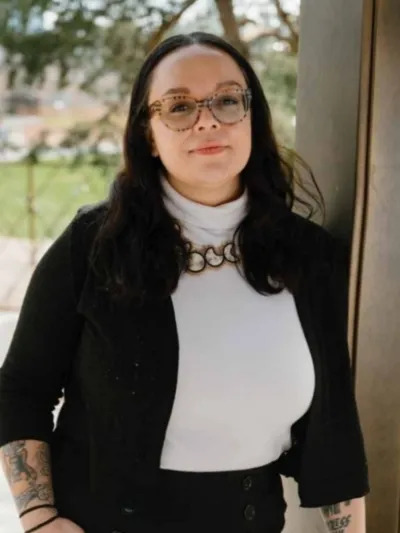

Trina Moyan
Advisor & Educator, First Peoples Advisory Office
John Daniels Faculty of Architecture, Landscape & Design (DFALD)
Trina Moyan is of the nehiyawak nation, the ‘four bodied human beings’, and is a member of the Frog Lake First Nation in northern Alberta. Trina is a multi-disciplined artist and award-winning Indigenous engagement specialist within architecture, landscape architecture and design projects in the City of Toronto. She began her career as a writer and producer for Aboriginal Peoples Television Network and CBC, and is co-founder of Bell & Bernard, a First Nations consulting firm focused on integrating Indigenous histories and contemporary realities into urban planning and design.
Moyan is also a muralist, playwright and traditional dancer committed to Indigenous empowerment through storytelling, ceremony, and civic design. Her life and work are inspired by her mother Jeanne, a residential school survivor, and her two sons.
Trina serves as an advisor and educator within the First Peoples office at the Daniels Faculty School. She also co-leads their first Indigenous high school access program supported by APUF for the 2025-26 term.
Jennifer Sylvester
PhD Student, Social Justice and Education, OISE; Instructor, Transitional Year Programme
Jennifer Sylvester is a member of Beausoleil First Nation. She identifies as Anishinaabekwe (Odawa, Pottawatomi, Ojibwa). Although she was born and raised in Toronto, her family often returns to their First Nation community whenever they can, and she has worked to pass on this tradition to her son.
She is currently working to complete her Ph.D in Leadership, Higher and Adult Education (LHAE) at the University of Toronto – Ontario Institute for Studies in Education (OISE). The focus of her research is on supporting Indigenous student success in academia, driven by her own experience as an Indigenous student.
She is currently a seminar instructor with the Transitional Year Programme (TYP), which she used to gain access to higher education, and successfully completed her HBA and M.Ed. During her time as an undergraduate student, she led and assisted with planning the Indigenous Studies Students’ Union (ISSU) Honouring Our Students PowWow in 2017 and 2018.
She is an advocate for Indigenous social issues, but, more importantly, for the equity, protection, and inclusion of Indigenous women.
